
Realizing children’s rights in Denmark
In 1991, Denmark ratified the Convention on the Rights of the Child (CRC). However, the Convention is not incorporated into Danish legislation by law, which means that it is not legally binding within the national legal system. Many challenges still hinder the fullest realisation of children’s rights in Denmark, namely related to violence against children, poverty, discrimination against Inuit children, mental health, and juvenile justice.
Population: 5.9 million
Pop. ages 0-14: 16%
Life expectancy: 82 years
Under-5 mortality rate: 3.4 ‰
Denmark at a glance
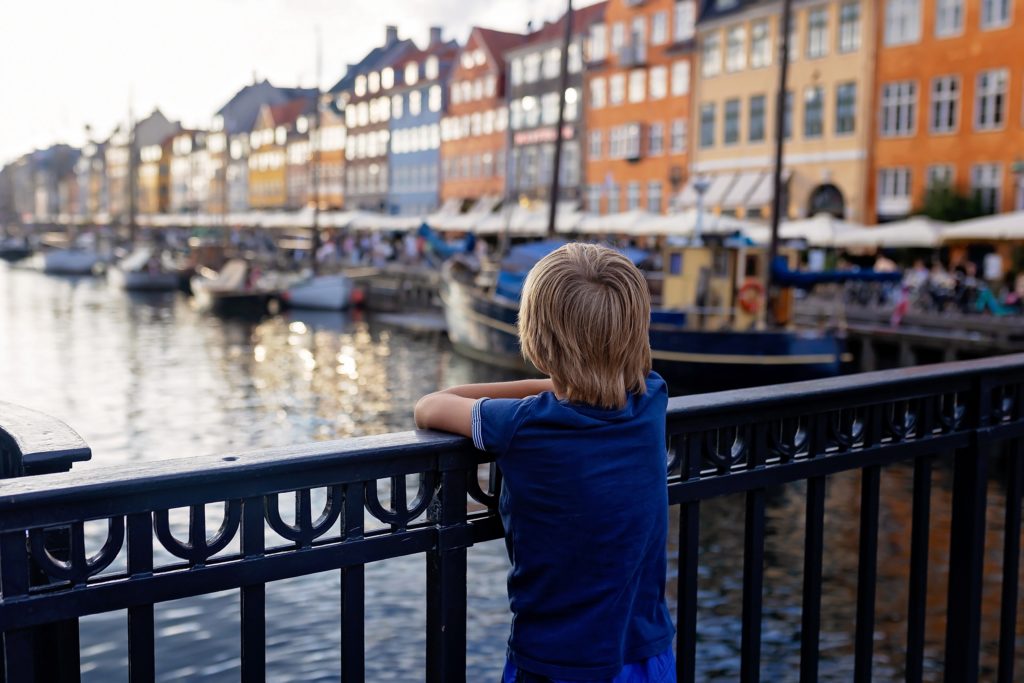
The Kingdom of Denmark (Kongeriget Danmark) is located in northern Europe and consists of the Jutland Peninsula and an archipelago of over 400 islands, the largest of which are Zealand, Funen, and Lolland. It shares a land border only with Germany to the south, while its maritime borders connect it to Sweden and Norway across the Skagerrak, Kattegat, and Øresund straits. Denmark also encompasses two autonomous territories: Greenland and the Faroe Islands, both situated in the North Atlantic Ocean (Britannica, 2025).
Historically a prominent Viking power, Denmark developed into a constitutional monarchy and has maintained political stability through the centuries. Though traditionally neutral, Denmark joined the North Atlantic Treaty Organisation (NATO) in 1949 and became a member of the European Economic Community (now the European Union) in 1973. In 2022, following a national referendum, Denmark ended its opt-out from the EU’s common defence policy, aligning more closely with European security initiatives (Campbell, 2022).
Denmark is known for its flat terrain, temperate climate, and high standard of living. When it comes to its population, around 84.2 percent identify as Danish, 1.1 percent identify as Turkish and 14.7 percent as other (including Polish, Romanian, Syrian, Ukrainian, German, and Iraqi). The official language is Danish, and Evangelical Lutheranism is the state religion, though other religious communities are also present. English is widely spoken as a second language (CIA World Factbook, 2025).
Status of children’s rights [1]
Denmark ratified the Convention on the Rights of the Child (CRC) on 19 July 1991, the Optional Protocol to the Convention on the Rights of the Child on the Involvement of Children in Armed Conflict (OPAC) in 2002, the Optional Protocol to the Convention on the Rights of the Child on the Sale of Children, Child Prostitution and Child Pornography (OPSC) in 2003 and the Optional Protocol to the Convention on the Rights of the Child on a Communications Procedure (OPIC) in 2015 (OHCHR, n.d).
However, as the CRC has not been incorporated into domestic legislation, it serves as a guiding principle rather than enforceable law. The legislator considers the CRC when adopting child-related legislation, but individuals cannot make a claim against an authority based solely on the Convention (Adolphsen, 2019).
As the legislation is constructed now, the primary legal protection of the child is provided by the parent. Therefore, it is the parents’ rights on behalf of the child and not the child’s rights that have been the main focus in the newer Danish legal history. As such, children’s rights in Denmark are often framed as participatory—such as being heard or involved—rather than as autonomous (Adolphsen, 2019).
In its concluding observations on Denmark’s fifth periodic report, the Committee on the Rights of the Child recommended that Denmark take measures to explicitly and fully incorporate all provisions of the Convention and its Optional Protocols into its national legislation to promote their application by the courts and administrative decision-making bodies (CRC, Concluding observations, 2017).
Addressing the needs of children in Denmark
Right to health
Denmark has a well-developed healthcare system, with numerous services focused on the prevention and early detection of health and well-being issues in children and young people. The municipalities and regions are responsible for the healthcare system (Youth Wiki, Health, 2023).
Children’s health is organised into primary, secondary, and tertiary healthcare systems. The primary health care is tax-funded and free at the point of use. All Danes are entitled to be listed with a GP (General Practitioner). The GPs are family doctors and work as gatekeepers to the secondary health care at the hospitals (Mathiesen, 2016).
In about 20 per cent of the GPs’ consultations, the patient is a child. Besides the regular consultations, the GPs perform preventive health examinations at the ages of 5 weeks, 5 months, and yearly until the age of 5 years. More than 90 per cent of children attend the initial 3 preventive health examinations (Mathiesen, 2016).
Immunisations are given according to the World Health Organisation recommendations, but some parents refuse to follow the recommendations. All parents are offered public health nurse visits within the first week of their child’s life. More than 90 per cent of parents accept these visits, and more visits are offered within the first 1-1.5 years. Free dentist visits are offered until the age of 18 years (Mathiesen, 2016).
When it comes to accessing health services, one key aspect is related to the minimum age of consent for medical treatments, which varies depending on the nature of the treatment, the obligations imposed on medical staff regarding the information given to parents, and the need for consent. In Denmark, the minimum age is set at 15 years. However, whether patients aged 15–17 years can consent to medical treatments without parental consent depends on their maturity, which is assessed on a case-by-case basis (FRA, 2018).
Right to education
The right to primary education and personal liberty is enshrined in the Constitution. Section 76 guarantees free education for all children of compulsory school age in public schools, unless parents provide a private alternative of equivalent standard (Adolphsen, 2019). The Public School Act details the length of compulsory education and ensures that all related expenses are covered by local authorities.
Parents have the freedom to make important decisions about their children’s upbringing, including education, residence, and health care. However, the Parental Responsibility Act requires that the child’s views be considered according to age and maturity (Hartoft, 2019). Parental education strongly influences children’s educational attainment. In Denmark, 61 per cent of adults with at least one parent holding a tertiary qualification also have tertiary education, compared to 23 per cent with parents lacking upper secondary education (OECD, 2024).
School staff must report children in need of social support, including cases of illegal school absence. If a parent refuses to ensure attendance, social services can issue orders and potentially withdraw child and housing benefits until the child returns to school (Adolphsen, 2019). Since the 2014 school reform, human rights education has been strengthened in schools, though the Committee on the Rights of the Child recommends making it mandatory and improving teacher training, especially to support access to cultural activities in Greenland (CRC, 2017).
Right to protection
Under Danish law, children are subject to parental custody. This implies that they have limited legal capacity. Custody contains two elements: the duty to take care of the child and the right to make decisions for the child. In the Act of Parental Responsibility, it is stated that parents have the right to make decisions in all private subjects concerning the child (Hartoft, 2019).
As a main rule, a child below the age of 18 cannot bring a case before a court in Denmark, and cases have to be taken to court by the parent on the child’s behalf. The same goes for administrative cases where the parent with custody over the child, who is also the child’s legal guardian, carries out the child’s rights (Adolphsen, 2019).
This means that, in general, children cannot enforce their own rights if the parents are not willing to put the case before a competent body. Even if the child is granted an individual right to complain, he or she will not be able to carry out his or her inherent rights in the absence of specific rules establishing such rights. Neither the right nor access to act on behalf of the child nor the parental duty to care for the child oblige the parent to start a case on behalf of the child, be that an administrative case or a court case (Adolphsen, 2019).
To ensure the child’s rights in cases where there is a risk of conflicting interest between the child and the parent with custody, specific rules allow for independent rights for children or require administrative or judicial procedures where the authorities play an active part to safeguard the child. A child aged 12 and above will, for instance, have a right to his or her own lawyer in cases regarding interventions (against the parents’ will) in the child’s family life and all social welfare procedures the authorities must speak directly with the child to get the child’s perspective – and the parent cannot oppose this (Adolphsen, 2019).
In the latter years, different age limits have been introduced in different areas of the law, allowing children an independent right to bring a case before an administrative complaint board. This is, for instance, the case regarding both voluntary measures and involuntary measures from the Social Welfare authorities, where a child can complain from the age of 12, even though his/her consent is not required to deem the measure voluntary (Adolphsen, 2019).
Right to freedom
The ultimate right to participate in a democracy is expressed by voting rights. Children and adolescents are not allowed to vote for the Parliament, the Regional Council or the Municipal Council. Neither are they allowed to vote for the EU Parliament. The right to vote is obtained at the age of 18 (Hartoft, 2019).
The voting age has been discussed several times in the Parliament and, most recently, in 2015– 2016. The proposal was that the voting age should be reduced to 16. This was motivated by the need to engage more young people in democracy and strengthen the participation of young people in elections. They are referred to in the report from the Electoral Commission. The debate in Parliament showed a large majority against changing the age of voting since matching the age of majority with the voting age seems already a good compromise (Hartoft, 2019).
However, children can engage civically through the Youth Councils, which exist in approximately two-thirds of the municipalities. However, there are differences in organisation and focus. For example, in a big city like Århus, the Youth City Council conducts seven city council meetings a year and has an annual dialogue meeting with the politicians in Århus’ City Council.
The Youth City Council is autonomous regarding which subjects and problems they discuss. The topics are extremely varied, from the desire for a better world to healthier food in schools, and to the establishment of a skating lane. The Youth City Council have the right to put forward four suggestions a year, which the Århus City Council is obligated to discuss (Hartoft, 2019).
Risk factors –> Country-specific challenges
Violence against children
A 2023 study involving 1,252 Danish general practitioners (GPs) revealed that 90 per cent had suspected child maltreatment at some point during their careers, and 85 per cent had submitted mandatory reports. Encouragingly, 79 per cent of respondents felt confident in managing such suspicions, and in 56 per cent of cases, they received feedback or witnessed further action being taken by relevant authorities (Munkholm, 2023).
Administrative data from 2014 to 2018 show a marked rise in referrals to Child Protection Services (CPS) in Denmark, from 64,800 in 2014 to 120,900 in 2018. By 2018, more than 10 per cent of all children under the age of 18 had been referred to CPS, with most notifications coming from public authorities such as schools, healthcare providers, and the police (Sidebotham, 2024). During the same period, Denmark, along with England, France, and Wales, recorded an average of 42 hospitalisations per 100,000 infants per year for serious physical abuse, with the incidence remaining generally stable and experiencing a slight rise in 2021 (Sidebotham, 2024).
Today, the legacy of abuse against Inuit women and girls during the 1960s and 1970s still persists. Many of them were fitted with an intrauterine device (IUD) by Danish doctors without consent. Many of the women were under the age of 12 (Jiménez Barca, 2025).
The objective, according to several studies, was to curb the population growth in Greenland, to prevent an escalating financial burden on Denmark. The case became known as the “Spiral Case,” after the shape of the coil, which some victims reported was quite painful. Many of these women had an IUD for years without knowing its purpose, and they never understood why they could not have children. The exact number of victims remains unknown. In September 2022, a joint commission consisting of Danish and Greenlandic scholars was formed to investigate the matter (Jiménez Barca, 2025).
Child poverty
In Denmark, children constitute 19.6 per cent of the total population, with 13.8 per cent living at risk of poverty and social exclusion as of 2022. Although this rate has decreased since 2021, following several years of increase, Denmark’s abolition of the official poverty line for families complicates direct comparisons of data over time. According to the Fairstart Foundation, the most vulnerable groups include children living below the poverty threshold and second-generation immigrant children (Eurochild, 2024).
Several factors contribute to the rise in child poverty: firstly, a general increase in wealth during the economic boom raised the income threshold for poverty indicators; secondly, unemployment increased following the 2008 economic crisis; and thirdly, the introduction of comparatively low cash benefits, such as “start help”, “introductory benefit”, and the “225-hour rule”, has limited support for some families (Eurochild, 2024).
For instance, the minimum work requirement, known as the “225-hour rules”, requires people on social assistance to demonstrate they have worked at least 225 hours in the previous 12 months (Cabinet Secretary for Social Justice, 2025). The “introductory benefit” was introduced for newly arrived refugees, replacing social assistance, with eligibility made conditional upon participation in an introduction programme (Bredgaard, Lind Ravn, 2021).
In early 2022, around 50,000 households with children received housing benefits, covering an estimated 40–60 per cent of their monthly rent depending on household composition. Local authorities assess and respond to public housing needs within their communities, providing financial support to develop new housing accordingly. However, eligibility for child allowances is restricted to Danish nationals or foreigners with between 1 and 3 years of residence in Denmark. While this policy aims to encourage employment among non-Danish residents, it excludes certain refugee groups, posing challenges for newly arrived children and their families (Eurochild, 2024).
Discrimination
In the 1950s, around 20 Inuit children aged five to nine were taken from villages in Greenland and sent to Copenhagen to learn Danish. The aim was to create a small elite group capable of leading the island towards modernity (Jiménez Barca, 2025). After two years, many had forgotten their native language and, instead of returning to their families, were placed in a kind of orphanage for further re-education (Jiménez Barca, 2025).
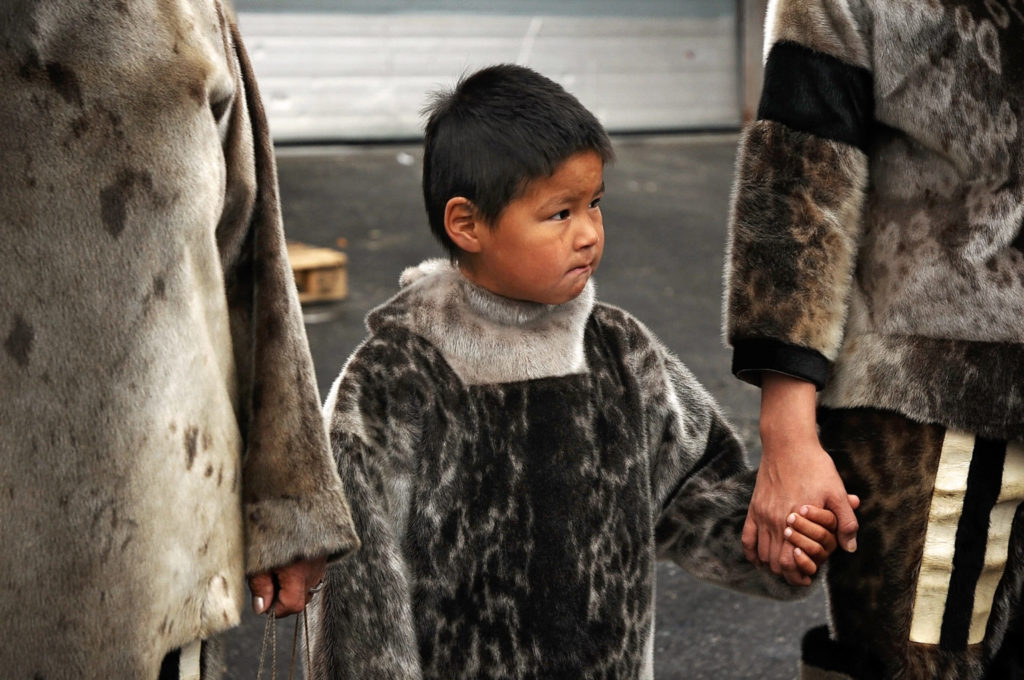
Over time, many of these children became lost, turning to alcohol or begging on the frozen streets of Nuuk, uprooted and aimless. Others ended up marrying Danes. In September 2022, Denmark’s Prime Minister, Mette Frederiksen, publicly apologised in front of six of these children, now elderly, the only ones still alive at the time. “What you were subjected to was terrible; it was inhumane, it was unfair, and it was heartless,” she told them (Jiménez Barca, 2025).
In February 2023, the Danish Parliament allocated DKK 7.8 million to strengthen case management and cooperation in child cases involving Greenlandic families. The initiative aims to prevent Danish authorities from testing Greenlandic citizens’ parenting skills on the wrong basis in connection with placement cases. The psychological tests used by the authorities today are not adapted to Greenlandic culture. As a result, there is a risk that Greenlandic parents will achieve a lower test score than in a culturally adapted test (Danish Institute for Human Rights, 2023).
According to the Danish Institute for Human Rights, misjudgements of Greenlandic parents’ parenting skills can have far-reaching consequences for both parents and children, as they can ultimately lead to the forced removal of a child who should not have been removed. Thus, the use of non-culturally adapted tests may pose a risk of Greenlanders in Denmark being discriminated against and their right to family life being violated (Danish Institute for Human Rights, 2023).
Displaced children
Denmark is currently seeing increasing political resistance to more inclusive migration policies, despite close to no progress being made towards a more open and supportive migration system. Instead, Denmark has introduced more restrictive laws for immigrants, in which immigrant families are being separated, and second-generation immigrants are denied citizenship.
Naturally, this also impacts children in these families, as they must endure being separated from their parents or carers. In contrast, children fleeing the war in Ukraine have been welcomed to Denmark, and they have received support from all sides (Eurochild, 2024).
Asylum seekers
Approximately one in three asylum seekers in Denmark is a child under 18, most of whom arrive with one or both parents and live together. Legally, these children are considered to be merely accompanying their parents, meaning their reasons for asylum are not assessed unless explicitly mentioned by their parents.
This practice contradicts UNHCR recommendations, which call for evaluating children’s independent claims where appropriate and conducting interviews based on their maturity. As from 2020s, children have begun receiving their own ID numbers. Children born to asylum seekers are issued Danish birth certificates, but are registered with their parents’ nationality. Those born to stateless parents may access Danish citizenship only if they have legal residence (Clante Bendixen, 2023).
Unaccompanied minors
Unaccompanied minors, mostly teenage boys, arrive without guardians and often lack age documentation. Authorities may subject them to age tests, which have faced criticism for inaccuracy. They live in specialised centres with Red Cross-appointed representatives, and their asylum applications follow the same process as adults. If rejected, unaccompanied minors may receive temporary residence only if they have no family in their home country, though this is rare and expires at age 18. They are not transferred under the Dublin Regulation unless they choose to be (Clante Bendixen, 2023).
Juvenile justice
In Denmark, the minimum age of criminal responsibility is 15 years. However, since the 2019 reform under the slogan “All actions have consequences,” children as young as 10 years old can encounter the justice system through a newly established Youth Crime Board (YCB) and Youth Probation Service (YPS). These institutions are authorised to impose mandated interventions and court-like proceedings on children aged 10 to 17 involved in violent or repeated offending (Henriksen et al., 2024).
Although the reform was introduced with the stated aim of preventing youth crime, it has been criticised for contributing to the criminalisation of children and for undermining essential legal safeguards. Concerns have been raised about the lack of access to due process, the limited appeal mechanisms, and the absence of specialised juvenile courts or child-sensitive procedures (Henriksen et al., 2024).
Prior to the 2019 reform, children under 15 could not be subjected to criminal procedures. The new system, although not formally lowering the age of criminal responsibility, effectively introduces punitive measures for children as young as 10, a practice that has been viewed as inconsistent with international standards recommending a minimum criminal age of 14 years and the prioritisation of non-judicial measures (Henriksen et al., 2024).
Additionally, children aged 15 to 17 can be held in pre-trial detention for up to eight months under the Administration of Justice Act, and may serve custodial sentences in adult prisons, raising serious concerns about their safety, well-being, and future reintegration (Henriksen et al., 2024).
Despite international recognition of the Nordic model’s emphasis on rehabilitation and child welfare, Denmark’s recent trajectory marks a shift toward more punitive youth justice practices. Legal scholars and rights organisations have argued that this trend diverges from the rehabilitative principles traditionally associated with the Nordic welfare model and may risk violating the principles enshrined in the Convention on the Rights of the Child (Henriksen et al., 2024).
Written by Arianna Braga
Internally proofread by Aditi Partha
Last updated on 20 June 2025
References:
Adolphsen, C. (2019). Chapter 7 Constitutional Rights for Danish Children. In Children’s Constitutional Rights in the Nordic Countries. Leiden, The Netherlands. Retrieved from Brill Nijhoff at https://doi.org/10.1163/9789004382817_008, accessed on 15 June 2025.
Bredgaard, T. Lind Ravn, R. (2021). Denmark: From integration to repatriation (Chapter 2). Retrieved from ETUI at https://www.etui.org/sites/default/files/2021-01/Chapter2-Denmark%20from%20integration%20to%20repatriation.pdf, accessed on 14 July 2025.
Britannica (2025). Country page of Denmark. Retrieved from Britannica at https://www.britannica.com/place/Denmark , accessed on 15 June 2025.
Cabinet Secretary for Social Justice (2025). International review of approaches to tackling child poverty: Denmark. Retrieved from The Scottish Government at https://www.gov.scot/publications/international-review-approaches-tackling-child-poverty-denmark/pages/4/, accessed on 14 July 2025.
Campbell, C. (2022). Denmark Just Reversed 30 Years of Euroskeptic Defense Policy—Thanks to Russia. Retrieved from Time at https://time.com/6183159/denmark-referendum-defense-eu-russia/ , accessed on 15 June 2025.
CIA World Factbook (2025). The World Factbook – Country page of Denmark. Retrieved from CIA at https://www.cia.gov/the-world-factbook/countries/denmark/ , accessed on 15 June 2025.
Clante Bendixen, M. (2023). Children in the asylum system. Retrieved from Refugees.dk – Informotaion on refugees in Denmark at https://refugees.dk/en/facts/the-asylum-procedure-in-denmark/children-in-the-asylum-system/ , accessed on 16 June 2025.
CRC, Concluding observations (2017). Concluding observations on the fifth periodic report of Denmark – Committee on the Rights of the Child. Retrieved from OHCHR at https://www.ohchr.org/en/documents/concluding-observations/crccdnkco5-committee-rights-child-concluding-observations-fifth , accessed on 15 June 225.
Danish Institute for Human Rights (2023). Human Rights in Focus 2022-2023. Retrieved from Danish Institute for Human Rights at https://www.humanrights.dk/files/media/document/HUMAN%20RIGHTS%20IN%20FOCUS%20%E2%80%93%20REPORT%20TO%20INATSISARTUT%202022-23_accessible.pdf , accessed on 20 June 2025.
Eurochild (2024). Country profile of Denmark. Retrieved from Eurochild at https://eurochild.org/uploads/2024/04/Denmark-Childrens-Rights-Political-will-or-wont.pdf , accessed on 15 June 2025.
FRA (2018). Consenting to medical treatment without parental consent. Retrieved from Fundamental Rights Agency – FRA at https://fra.europa.eu/en/publication/2017/mapping-minimum-age-requirements-concerning-rights-child-eu/consenting-medical-treatment-without-parental-consent , accessed on 19 June 2025.
Hartoft, H. (2019). Children’s Right to Participation in Denmark: What Is the Difference between Hearing, Co-Determination and Self-Determination? Retrieved from Research Gate at https://www.researchgate.net/publication/337704213_Children’s_Right_to_Participation_in_Denmark_What_Is_the_Difference_between_Hearing_Co-Determination_and_Self-Determination , accessed on 20 June 2025.
Healthcare Denmark (n.d.). The Danish Approach to Mental Health. Retrieved from Healthcare Denmark at https://healthcaredenmark.dk/media/mcockmni/3i-mental-health-pdf-uk.pdf , accessed on 20 June 2025.
Henriksen, A. K., Bengtsson, T. T., & Henriksen, T. D. (2024). Crime Prevention, Support or Punishment? Introducing an Ambiguous System of Youth Justice in Denmark. Retrieved from Youth Justice, 24(3), 463-479 at https://doi.org/10.1177/14732254241239016 , accessed on 15 June 2025.
Jiménez Barca, A (2025). Denmark’s dark history with Greenland: Children torn from their families and women forcibly fitted with IUDs. Retrieved from El País at https://english.elpais.com/international/2025-01-15/the-deep-scars-between-greenland-and-denmark-children-torn-from-their-families-and-women-forcibly-fitted-with-iuds.html , accessed on 16 June 2025.
Mathiesen et al. (2016). The Child Health System in Denmark: Current Problems and Successes. Retrieved from The Journal of Pediatrics at https://www.jpeds.com/article/S0022-3476(16)30145-7/fulltext , accessed on 20 June 2025.
Munkholm, A., et al. (2023). General practitioners’ experiences and attitudes toward mandatory reporting of child maltreatment in Denmark: A cross-sectional survey study. Retrieved from PubMed at https://pubmed.ncbi.nlm.nih.gov/36924625/ , accessed on 20 June 2025.
OECD (2024). Education at a Glance 2024 – Country Report on Denmark. Retrieved from O>ECD at https://www.oecd.org/content/dam/oecd/en/publications/reports/2024/09/education-at-a-glance-2024-country-notes_532eb29d/denmark_1f1f0b8c/4cbbcbd3-en.pdf , accessed on 16 June 2025.
OHCHR (n.d.). UN Treaty Body Database – Denmark. Retrieved from OHCHR at https://tbinternet.ohchr.org/_layouts/15/TreatyBodyExternal/Treaty.aspx?CountryID=49&Lang=en , accessed on 15 June 2025.
Sidebotham, P., et al. (2024). Trends in serious injuries from child physical abuse in young children in four European countries from 2013 to 2021. Retrieved from PMC at https://pmc.ncbi.nlm.nih.gov/articles/PMC11236184/ , accessed on 20 June 2025.
Youth Wiki, Health, (2023). Denmark – Health and Well-being. Retrieved from European Commission at https://national-policies.eacea.ec.europa.eu/youthwiki/chapters/denmark/7-health-and-well-being , accessed on 20 June 2025.
Youth Wiki, Mental health (2023). Denmark – Mental health. Retrieved from European Commission at https://national-policies.eacea.ec.europa.eu/youthwiki/chapters/denmark/75-mental-health , accessed on 20 June 2025.
[1] This article by no means purports to give a full or representative account of children’s rights in Denmark; indeed, one of many challenges is the scant updated information on the children of Denmark, much of which is unreliable, not representative, outdated or simply non-existent.